Overview
If you are planning to move around Kanagawa by train or bus, the single most useful thing to sort out before you land is how you will pay for fares. Japan’s stored-value transit cards — Suica and PASMO, collectively known as IC cards — let you tap in and out of most trains, subways and many buses without buying a paper ticket every time. For a traveller based in Yokohama, Kamakura, Hakone or the Shonan coast, that convenience compounds quickly: a single Kamakura day trip can involve an JR line, a private railway, a local bus and a seaside tram, and paying cash for each leg is slower and easier to get wrong.
This guide explains what IC cards actually do in 2026, how Suica, PASMO and their smartphone versions differ, where to buy and top them up in Kanagawa, how they work on trains, buses and the Enoden, what the deposit and refund rules are, and the mistakes that catch first-time visitors. Prices, card availability and app requirements can change, so treat the figures below as the ranges you should expect and confirm the current details at a station office or in the official app.
What an IC Card Actually Does
An IC card is a rechargeable prepaid card with a contactless chip. You load money onto it (a process usually called “charging” or “topping up”), then touch it to a reader at a ticket gate or on a bus. The correct fare is deducted automatically based on where you entered and exited, and the remaining balance is shown on the gate display.
Three properties matter most for visitors:
- It replaces most ticket purchases. On participating railways you do not need to calculate fares or queue at a machine — tapping at both ends is enough.
- It carries a deposit, not a fee. A physical card normally includes a refundable deposit of around ¥500, so a ¥2,000 purchase usually leaves roughly ¥1,500 of usable balance.
- It is not a discount pass. IC cards give you convenience and a small time saving, but the fare is generally the same as a paper ticket. If you want savings, you need a dedicated pass such as the Enoden 1-Day Pass or the Hakone Free Pass, which we cover in our Enoden 1-Day Pass guide and our Hakone access guide. In practice the two work together: use the pass for the discounted legs and the IC card for everything in between.
IC cards are also usable for many small purchases — convenience stores, vending machines, coin lockers and some cafes — which is why they are often described as a travel wallet rather than simply a train ticket.
Suica vs PASMO vs Mobile Suica
The two nationwide-compatible cards are Suica (JR East) and PASMO (private railway group). For a visitor in Kanagawa the practical difference is small: both are rechargeable stored-value cards that work on each other’s networks, on the Yokohama municipal subway, on most city and community buses that display the IC logo, and on the Enoden. Both can also be used for shopping. Choose whichever you find first; you are not locked in.
The meaningful choice in 2026 is between a physical card and a mobile card in your phone.
| Option | How it works | Best for | Things to know |
|---|---|---|---|
| Physical Suica / PASMO | Plastic card bought at a station machine or office; tap the card on the reader | First-time visitors, families, anyone who prefers not to depend on a phone battery | Usually includes a refundable deposit (around ¥500). Availability of new cards has fluctuated since the 2024 chip shortage, so buy early in your trip and keep the card safe — it is not registered to you unless you buy a registered version. |
| Mobile Suica | Card held in Apple Wallet on iPhone or in the Suica app on supported Android phones | iPhone users, repeat visitors, travellers who want to top up instantly | Requires a compatible phone with contactless support. Add the card, charge it with a credit card or prepaid balance, then tap the phone. Works even when the screen is locked on most devices. |
| Mobile PASMO | Card in Apple Wallet or the PASMO app | Android users and iPhone users who prefer PASMO | Same idea as Mobile Suica. Note that transfers between phone-based card systems must be done through the official procedures. |
| IC card on a foreign-issued phone | Add the card via Wallet without a Japanese phone number | Short trips | Foreign-issued cards and accounts work with Apple Wallet transit cards; some Android features remain region-restricted. Check before you rely on it for a whole trip. |
One practical warning: a phone-based card lives in the phone. Losing the device or letting the battery die mid-journey leaves you paying cash, so many travellers keep a small amount of cash and one physical card as a fallback. Conversely, a physical card can be lost or demagnetised, while a phone card can often be restored through the app’s account recovery.
Whatever you choose, you do not need both a Suica and a PASMO: pick one and keep your balance in a single place. If you expect heavy travel, look at the pass options first and use the IC card for the gaps, which is the pattern we describe in our Kamakura access guide.
Where to Buy and Top Up in Kanagawa
You have three realistic purchase points, and all three are easy to reach from a Kanagawa itinerary.
- Ticket machines at major stations. Look for machines marked with the IC logo and an English language option. Yokohama, Shin-Yokohama, Ofuna, Fujisawa and Odawara are the usual first stops for Kanagawa trips and all have machine banks with English menus. Insert cash or use a supported card, pay the deposit plus your chosen balance, and take the card. Keep the receipt until you have tapped in successfully at least once — it makes troubleshooting far easier if something goes wrong.
- Station offices (Midori-no-madoguchi) and travel service counters. If a machine will not sell a new card, or you want a registered card with your name on it, ask at the office. Staff can also handle refunds and balance queries, and many offices have English-speaking staff or a translation tool.
- Mobile within minutes. If you use a phone card, there is no queue at all: add the card, charge it with a credit card, and you are ready before you reach the platform. This is the fastest option if you land at Haneda or Narita and want to move without stopping at a counter.
Topping up is equally straightforward. Station machines accept cash and, on many models, credit cards; convenience stores such as the large chains found on every Kanagawa high street can also charge a physical card at the counter. Mobile cards can be charged from inside the app with a registered payment method. Two habits worth adopting: top up more than you think you need on arrival (roughly ¥2,000–3,000 covers a day of moderate travel), and never let the balance fall to zero before a journey, because a card with insufficient balance will refuse entry and send you back to a machine.

If your trip reaches beyond Kanagawa into Tokyo, Nikko or Fuji Five Lakes, compare pass coverage before you buy separate tickets. A regional pass bought in advance will often beat paying fares leg by leg, and the IC card then covers only the sections the pass does not. Check current regional pass options for the Greater Tokyo and Kanagawa area and compare them against your planned route; a rail pass and an IC card used together is usually the cheapest and simplest combination for a multi-day stay.

Using IC Cards on Trains, Buses and the Enoden
On railways, the routine is the same everywhere: touch the card to the reader as you pass through the gate, then touch it again on exit. The fare is calculated from the two records. If you forget to tap out, the system cannot tell where you left the network, and you will be charged the maximum fare for that line — which is the single most common avoidable cost for visitors.
Kanagawa specifics worth knowing:
- JR lines (Tokaido, Yokosuka, Negishi, Shonan-Shinjuku) accept IC cards throughout, including Yokohama, Ofuna, Kamakura, Fujisawa and Odawara.
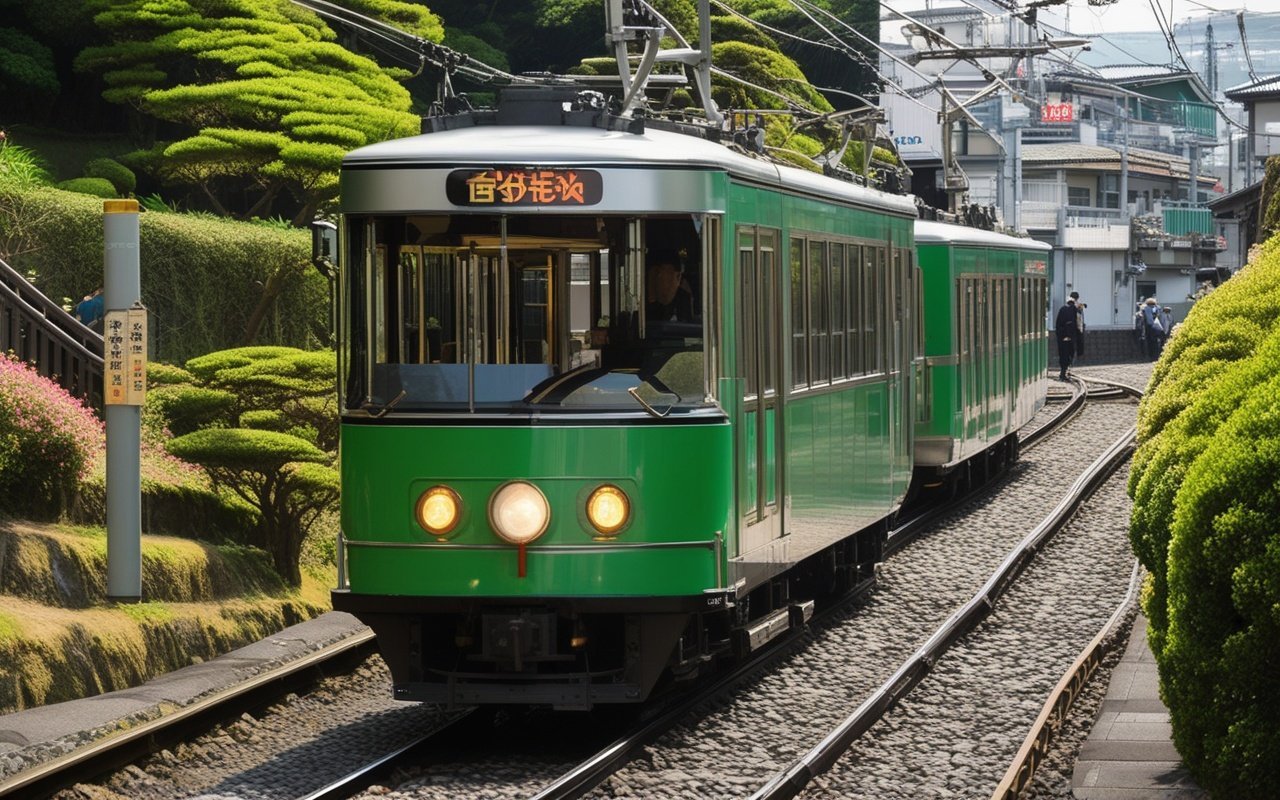
- Private railways such as Odakyu, Tokyu, Keikyu, Sotetsu and the Enoshima Electric Railway (Enoden) accept IC cards. The Enoden is the classic example: tapping on and off at Kamakura and Enoshima is quick, though a 1-Day Pass is usually better value if you ride more than twice in a day.
- Yokohama’s municipal subway and the Minatomirai Line accept IC cards, which makes a Yokohama-to-Kamakura combination easy.
- Buses are the exception to memorise. Most buses that display the IC logo take the card, but some community and tourist buses are cash-only, and rural routes may require exact change. On IC buses you tap once on boarding (flat-fare systems) or tap on entry and again on exit (distance-based systems); watch the reader markings above the door.
- Ferries, ropeways and the Hakone sightseeing network mostly do not take IC cards as payment, which is another reason the Hakone Free Pass pays for itself; see our Hakone access guide for the combination that works.

Fares, Deposits and Refunds
IC fares are distance-based and generally match the paper fare. Typical Kanagawa journeys sit in these ranges, which are useful for budgeting rather than for exact planning:
| Journey type | Typical IC fare |
|---|---|
| Short urban hop (a few stops on a Yokohama or Kamakura line) | roughly ¥150–250 |
| Kamakura to Enoshima on the Enoden | roughly ¥200–300 |
| Yokohama to Kamakura on JR | roughly ¥400–500 |
| Central Tokyo to Odawara or Hakone area | roughly ¥1,000–2,000 depending on route and limited express supplement |
| Local bus, flat fare | roughly ¥200–300 |
The deposit is the part visitors misread. A physical card usually bundles a refundable deposit of around ¥500 with whatever balance you loaded, so a ¥1,000 purchase leaves about ¥500 to spend. When you leave Japan, you can return the card at a station office: the balance is refunded, minus a small handling fee in many cases, and the deposit is returned. If your balance is nearly zero, the deposit can still be refunded — but the fee may consume the remaining balance, so it is often simpler to spend the balance down at a convenience store on your final day and keep or hand back the card accordingly.
Two further points: a card that has sat unused for around ten years may stop working, and a card with a negative balance cannot happen — the system simply refuses entry. That is why carrying a small cash reserve remains sensible even when you rely on IC cards.

Common Mistakes and Etiquette
Almost every IC card problem a visitor hits comes from one of the following, and each has a simple fix.
- Forgetting to tap out. The consequence is the maximum fare for that line, charged when you try to exit or on your next tap. The fix is to tap out every single time, including at unstaffed stations and when you change to a bus. If you realise shortly afterwards, speak to station staff rather than ignoring it — they can often adjust the charge at the office.
- Two cards, two balances. Buying a Suica one day and a PASMO the next splits your money and confuses refunds. Keep one card and top it up.
- Assuming every bus takes a card. Check the IC logo at the door and on the fare board. If it is absent, you need cash, ideally coins, because many rural buses do not break notes.
- Tapping a phone and a card together. If both are in the same hand or the same wallet, the reader may pick up the wrong one and record a journey against the wrong balance. Keep them separate, or store the physical card away from the phone.
- Expecting a discount. IC cards are a convenience, not a saving. Budget for fares as listed above and look to passes for the discounts.
- Losing the card. Unregistered cards cannot be replaced with the balance intact. Registering a card (or using a phone card with account recovery) is the safer choice for longer stays.
Etiquette is worth a moment, because transit in Kanagawa is busy and quiet. Keep your phone on silent, avoid phone calls on trains, and do not eat on commuter services; a drink is generally acceptable on longer trains. When the carriage is full, take your backpack off and hold it in front of you. If you have luggage, aim for the ends of carriages and, in the morning and evening peaks, consider sending bags ahead instead of carrying them — our luggage and connectivity guides cover the services that make this practical.
Practical Tips for Kanagawa Trips
- Work out your pass-and-card split on day one. If a day involves more than two rides on one private line, a day pass usually wins; the IC card covers the rest. The Enoden and Hakone cases are the clearest examples.
- Keep ¥2,000–3,000 of charge as a floor. That covers a typical day of local trains and buses without a mid-journey top-up stop.
- Charge before you need it. Station machines are everywhere in Yokohama and Kamakura, but they are much rarer at small coastal stations and on rural bus routes.
- Plan connectivity early. Mobile IC cards, maps with live departure data, and seat reservations all depend on data. Sorting out a data eSIM or pocket Wi-Fi before you arrive makes every other step easier — see our Japan SIM and eSIM guide.
- Photograph your card. A photo of the card number makes it far easier to explain the situation to station staff if it is lost or a gate misreads it.
- Keep small coins. They are the fallback for the cash-only buses and the rural shops that still do not take cards.
- Check before relying on a physical card. Newly issued physical cards have been subject to availability limits in recent years. Confirm at the station office, or simply set up a phone card and skip the queue.
IC Card vs Paper Ticket vs Day Pass: What to Choose
Visitors often ask whether an IC card replaces the need for passes. It does not, and the two do different jobs. Here is how the three payment options compare on the routes most travellers actually ride in Kanagawa.
| Option | What it is good for | When it loses | Typical use |
|---|---|---|---|
| IC card | Any journey on a participating line or bus, without calculating fares; also works for shops and lockers | When you ride one line repeatedly in a single day; it gives no discount | Mixed itineraries across JR, private railways and buses |
| Paper ticket | One-off journeys where you already know the exact fare, and on cash-only buses | When you transfer often; each transfer means another machine queue | Rural buses and the occasional single ride |
| Day pass | Repeated rides on one operator’s network in one day; often includes small extras such as discounts at nearby attractions | When your day is spread across several operators that the pass does not cover | Enoden sightseeing days, Hakone loop days, and museum-heavy Yokohama days |
The rule of thumb that works for most Kanagawa itineraries is this: buy the pass for the line that forms the spine of your day, and keep the IC card for every other leg. On an Enoden day that means the 1-Day Pass covers the tram rides while the card covers the JR leg from Yokohama and the bus to a trailhead. On a Hakone day it means the Free Pass covers the ropeway, the sightseeing boats and most of the mountain transport, with the card used only for the section that falls outside the pass area — a pattern we break down in our Hakone access guide.
Because pass prices and coverage change with the season and the operator, the reliable method is to add up your planned rides before you leave the station: if the pass costs less than the sum of the individual fares you intend to travel, it wins. If it does not, the IC card alone is enough. Where the calculation is close, remember that a pass also removes the small friction of buying tickets each time, which on a crowded weekend in Kamakura is worth something in itself.
Finally, do not overlook the value of holding both at once. The card is your fallback when a pass runs out of area or when a plan changes mid-day, and the pass is your discount layer when the itinerary is fixed. Carrying both costs almost nothing in weight and removes most of the friction from a Kanagawa transit day.
Frequently Asked Questions
Can I use a Suica on the Enoden?
Yes. The Enoden accepts IC cards, and tapping on and off works at its stations. If you plan to hop on and off through the day, compare the fare total with the 1-Day Pass before you decide; the pass usually wins after two or three rides.
Does an IC card save money on fares?
Not directly. The fare is normally the same as a paper ticket. The savings come from passes, and from the time you save by not queueing at machines each time you transfer.
What happens if I forget to tap out?
You will be charged the maximum fare for that line. Speak to station staff as soon as you notice; they can often correct the record at the office window.
Is Mobile Suica cheaper than a physical card?
The fares are the same. A phone card avoids the physical card’s deposit in most cases and removes the risk of a lost card, but it depends on a charged phone. Many travellers use a phone card as the primary and keep a small cash reserve as backup.
Do IC cards work on buses in Hakone and along the coast?
They work on many, but not all. Bus services that display the IC logo accept them; some tourist and community services remain cash-only. If a pass covers the area — as the Hakone Free Pass does for much of the region — you may not need the card for those legs at all.
Can I get my deposit back?
Normally yes, when you return a physical card at a station office. A small handling fee may apply, and the fee can absorb a nearly empty balance, so spending the balance down at a convenience store on your last day is a common approach.
Conclusion
An IC card is the lowest-effort upgrade you can make to a Kanagawa trip. Decide between a physical card and a phone card before you land, load enough to cover a full day, tap out every time, and treat passes such as the Enoden 1-Day Pass or the Hakone Free Pass as the discount layer that sits on top. Used that way, the card quietly removes the small frictions — ticket queues, exact change, and unfamiliar fare tables — that otherwise eat into a short visit.
For the next steps, plan your rail days with the Enoden 1-Day Pass guide and the Hakone access guide, check the connections in our Kamakura access guide, and sort out data with our Japan SIM and eSIM guide. If your route crosses into Tokyo or beyond, compare a regional pass for the long legs and keep the IC card for everything in between.
Fares, card availability and app requirements change. Treat the ranges in this guide as planning figures and confirm current details at a station office or in the official app before you travel.
本記事には広告(アフィリエイト)リンクが含まれます。リンク経由で予約・購入された場合、当サイトに手数料が発生することがありますが、読者の支払額は変わりません。掲載内容は編集方針に基づき、公式情報を優先しています。Affiliate Disclosure