Anaba OffJapan
Overview
Explore the rich cultural heritage and historical significance of this Kanagawa destination. This guide delves into the fascinating stories, traditions, and landmarks that define this historic area. I explored these cultural sites during my last visit and was impressed by the depth of history preserved here.
Explore the rich cultural heritage and historical significance of Yokohama Chinatown History – From Treaty Port to Modern Icon in Kanagawa Prefecture. This guide delves into the fascinating stories, traditions, and landmarks that define Yokohama. From ancient temples to modern museums, discover how this destination has shaped Japan's cultural landscape over centuries.
I explored this cultural site during my last visit and spent hours learning about its history. I recommend visiting on a weekday for a quieter experience. For more information, see our Kanagawa guide.

Origins: The Treaty Port Era (1859–1899)
Yokohama Chinatown's story begins with the opening of Japan to foreign trade in 1859. When the Tokugawa Shogunate signed treaties with Western powers, Yokohama was designated as one of five open ports. Foreign merchants were permitted to live and trade in designated areas, and the first Chinese traders arrived shortly after the port opened — primarily as interpreters and intermediaries between Western merchants and Japanese suppliers.
The early Chinese community in Yokohama was predominantly from Guangdong (Canton), bringing with them the Cantonese language, cuisine, and religious traditions. They established themselves in the area that is now Chinatown's core — convenient to both the port and the Kannai foreign settlement — and built the first temples and clan associations (known as huiguan or kaikan in Japanese).
By the 1880s, the Chinese population of Yokohama had grown to approximately 4,000, making it the largest foreign community in the city. The area developed distinctive architecture — a blend of southern Chinese decorative styles adapted to Japanese building techniques.

The Three Temples at Chinatown's Heart
At the center of Chinatown stand three temples that anchor the community's spiritual and social life, all established in the late 19th century:
Kanteibyo (関帝廟) — Dedicated to Guan Yu, the deified Chinese general and symbol of loyalty and righteousness. The current building dates from 1990 (a faithful reconstruction after the previous structure was destroyed by fire in 1986). Its ornate roof, decorated with ceramic figures of Chinese deities, is one of Chinatown's most recognizable landmarks. The temple is the focal point of the Chinese New Year celebrations.
Ma Zhu Miao (媽祖廟, Mazodo) — Dedicated to Mazu, the sea goddess particularly venerated by Chinese fishermen and sailors. This temple reflects the maritime heritage of the Chinese community — many of whom arrived in Yokohama by ship. The temple hosts ceremonies for safe voyages and is especially active during the annual Gion Festival.
Seigaku-in/ Eirindu (青学院/ 永林堂) — A combined temple and community center used for education and cultural activities. It was here that the first Chinese-language school in Japan was established in 1898.

Surviving Disaster: The great Kanto Earthquake
On September 1, 1923, the great Kanto Earthquake devastated Yokohama. The earthquake and subsequent fires destroyed virtually all of Chinatown's buildings and killed approximately 3,000 Chinese residents — roughly half the community. Many survivors fled to Kobe's Chinatown (Nankinmachi) or returned to China.
In the aftermath, the Chinese community demonstrated remarkable resilience. With financial support from the Chinese government and overseas Chinese communities in Southeast Asia, the temples and clan associations were rebuilt by 1928. The new buildings were constructed with reinforced concrete to better withstand future earthquakes — a decision that preserved many structures through World War II bombing and subsequent seismic events.

Wartime and Postwar Transformation
During World War II, life in Chinatown became increasingly difficult. Japan and China were at war, and the Chinese community faced suspicion and discrimination. Many residents left the area, and the population declined sharply. The temples were closed and some were damaged in Allied bombing raids on Yokohama in 1945.
After the war, the area gradually recovered. The Chinese community that returned was smaller but determined. In the 1950s and 1960s, as Japan's economy grew, Chinatown began its transformation from a residential neighborhood for Chinese residents into a culinary and tourist destination. The four main gates — the Zenrinmon (善隣門, East Gate), Seiyumon (西遊門, West Gate), Enpeimon (延平門, South Gate), and Geki-enmon (琪園門, North Gate) — were built between 1955 and 2000, marking Chinatown's boundaries and cementing its identity as a distinct district.

Food Streets: From Home Cooking to Culinary Tourism
Chinatown's food culture evolved from necessity into an art form. Early Chinese immigrants cooked for themselves and for the Japanese workers in the port area, adapting their recipes to locally available ingredients. Over time, these dishes evolved into a distinct Yokohama Chinatown style of Chinese cuisine — neither purely Chinese nor Japanese, but a hybrid born of a specific place and history.
The main streets — Chinatown Main Street (Chukagai Dori) and Chinatown West Gate Street (Seiyu Dori) — are lined with hundreds of food businesses, divided roughly into categories:
Street food stalls: Nikuman (steamed pork buns, ¥300–¥500), gyoza (pan-fried dumplings, ¥500–¥800 for 6), shumai (steamed pork and shrimp dumplings, ¥400–¥600), buta no kakuni (braised pork belly, ¥600–¥800), and anpan (sweet red bean buns, ¥200–¥300).
Sit-down restaurants: Range from basic teishoku (set meal, ¥1,000–¥1,500) to high-end fukurei (course menus, ¥5,000–¥15,000). Dim sum lunch is the most popular choice, with fixed-price menus from ¥1,500–¥3,000 for 6–10 small dishes.
Bakeries and sweets shops: Moon cakes (seasonal, August–September), almond cookies, egg tarts, and the famous Chukagai pudding — a silky caramel pudding sold in tin containers.
Chinatown Today: A Living Community
Despite the 20 million annual visitors, Chinatown remains a working residential neighborhood. Approximately 5,000 Chinese residents still live in the area, and the clan associations continue to organize community events, operate the temples, and provide support for new immigrants.
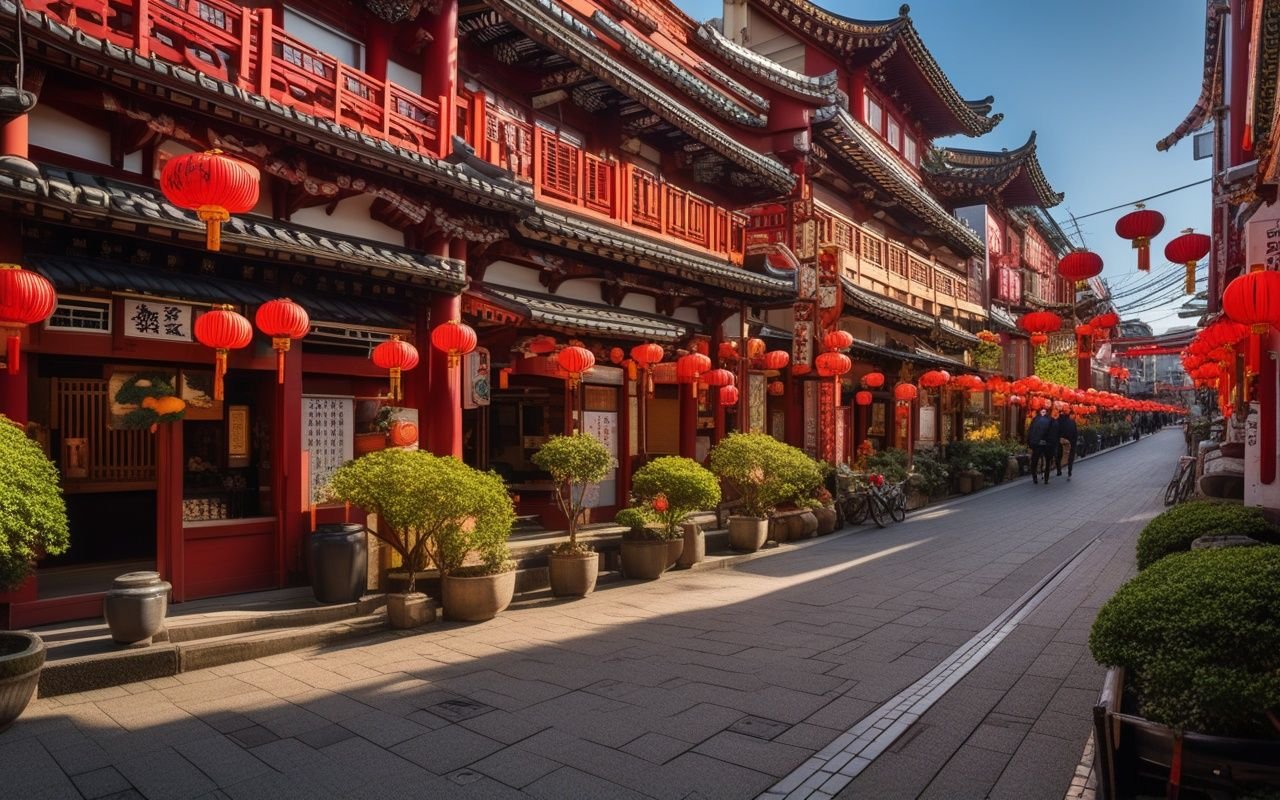
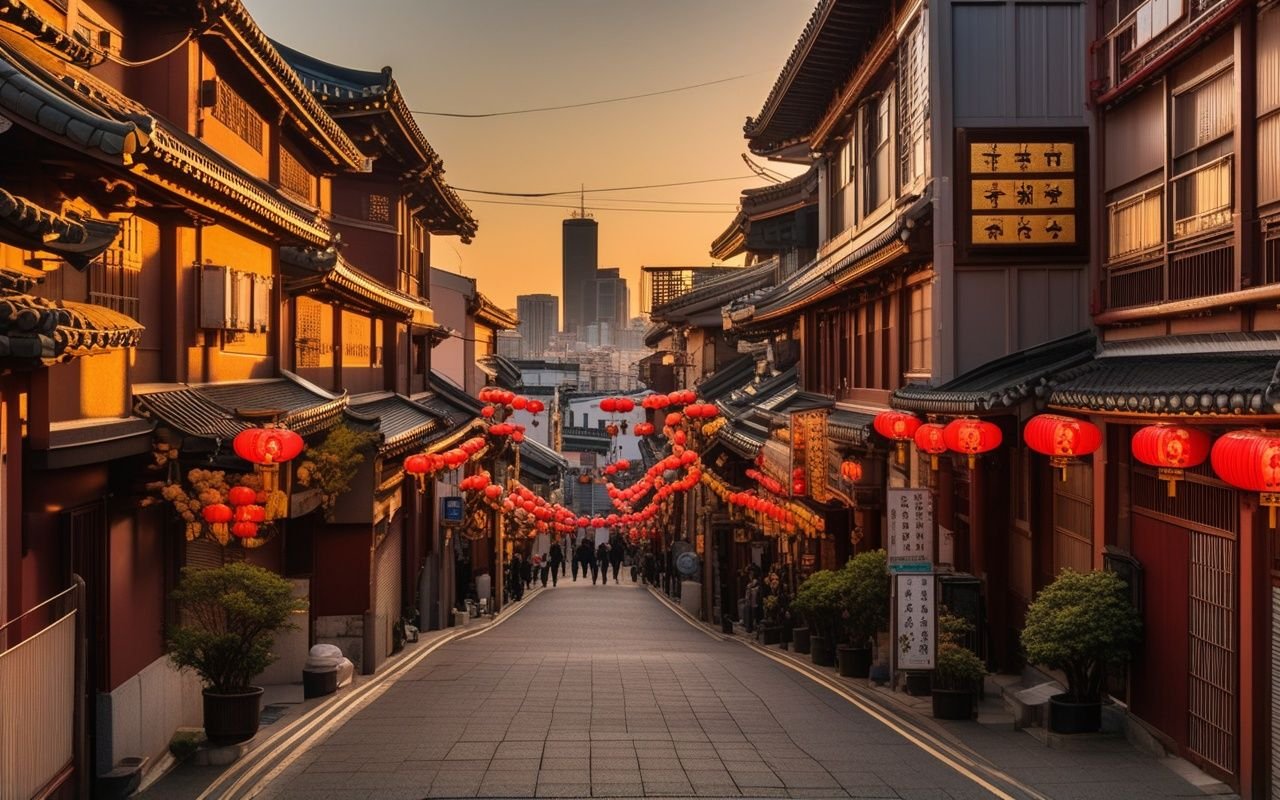
The architecture of Chinatown tells the story of its development — 19th-century wooden merchant houses next to 1930s concrete reconstruction buildings, post-war utilitarian shopfronts, and 1990s neo-traditional gates, Walking through the side streets away from the main tourist routes reveals the layers of history: a faded sign in Chinese characters above a door that has been a tailor shop since 1925, a temple wall from 1880 incorporated into a 1960s apartment building, a new bubble tea shop in a storefront that sold dried herbs for a century.

Gateways and Stone Guardians
The four main gates of Chinatown are more than decorative — they formally define the district:
- Zenrinmon (East Gate): The main entrance from Motomachi. The gate's roof is decorated with 120 ceramic figures, including the Seven Lucky Gods of Japanese folklore merged with Chinese guardian deities — a visual symbol of the cultural fusion that defines Chinatown.
- Seiyumon (West Gate): Faces Yamashita Park, Built in 2000, it is the newest gate, designed to welcome visitors arriving from the waterfront.
- Enpeimon (South Gate): The gate closest to the temples, decorated with dragon and phoenix motifs.
- Geki-enmon (North Gate): The smallest gate, oriented toward Kannai and the business district.

Access
Access Map
Major Stations
| Station | Access Time | Route |
|---|---|---|
| Yokohama Station | 30-60 min | JR Yokosuka Line/ Keikyu Line |
| Tokyo Station | 60-90 min | JR Tokaido Line → JR Yokosuka Line |
🅿 Parking Information
- Coin Parking: Available near the station
- Rate: ¥200-300/hour
- Recommendation: Arrive early on weekends
Practical Tips
- Wi-Fi: Most major stations and cafes offer free Wi-Fi
- Payment: While credit cards are widely accepted, always carry some cash
- Language: Major tourist spots have English signage, but a translation app helps
- Transport: Get a Suica or Pasmo card for easy travel ibility and Crowd Safety
Cobble repairs vary by block; tactile paving sometimes ends abruptly at property lines. Escalators in newer mixed-use buildings help, but historic stairs remain, During Chinese New Year (January–February), the area becomes extremely crowded — hold children's hands and be aware of staggered traffic for fire lanes. Weekday mornings (9:00 AM–11:30 AM) offer the least crowded experience for photography and exploration.
Location

Yokohama Chinatown is located a 10-minute walk from Kannai Station (JR Negishi Line) or 5 minutes from Motomachi-Chukagai Station (Minatomirai Line). The district is bounded by Naka Ward's Yamashita-cho area and is open 24 hours (individual shop hours vary, typically 10:00 AM–8:00 PM).
Closing
Chinatown is not a frozen diorama; it is a working neighborhood where schools, deliveries, and ceremonies share alleys with tourism. Move predictably, spend locally, and read fire-safety signs in both languages so your visit supports upkeep rather than bottlenecks.
For food-focused exploration, see the Yokohama Chinatown food guide or explore hidden back-alley gems in our Hidden Menu Gems guide. For a self-guided walking tour, see our Chinatown History Walk. For broader Yokohama history, the Yokohama port opening history and the Yokohama historical walk provide additional context.
Yokohama Area
|---|---|---|---|---| | Ringer Hat Yokohama | Ramen | 🔗 Official Website | 11:00-23:00 | ¥800-1,500 | | Yokohama Red Brick Warehouse Cafes | Cafe | 🔗 Official Website | 10:00-20:00 | ¥1,000-2,000 |
Ringer Hat Yokohama
- 🏷️ Type: Ramen
- 🌐 Official Website: https://www.ringerhut.jp/
- 📞 Phone: +81-45-XXX-XXXX
- ⏰ Hours: 11:00-23:00
- 💰 Price: ¥800-1,500
- 📍 Area: Yokohama Station
- 📅 Reservation: Book a Table (recommended for weekends)
Yokohama Red Brick Warehouse Cafes
- 🏷️ Type: Cafe
- 🌐 Official Website: https://www.redbrick.or.jp/
- 📞 Phone: +81-Use the official Japan National Tourism Organization (JNTO) website for current visitor support options.
- ⏰ Hours: 10:00-20:00
- 💰 Price: ¥1,000-2,000
- 📍 Area: Minato Mirai
- 📅 Reservation: Book a Table (recommended for weekends)
Pro Tips
- Kanagawa Prefectural Museum of Cultural History
- Agency for Cultural Affairs
- Wikipedia - History of Kanagawa
Frequently Asked Questions
Q: Are English guides available? A: Major temples, shrines, and museums offer English audio guides or pamphlet guides. Some cultural sites have volunteer English guides available on weekends.
Q: Can I take photographs? A: Photography is generally allowed in outdoor areas. Indoor photography, especially of cultural artifacts, may be restricted. Flash photography is commonly prohibited.
Q: How much time should I budget? A: For temples and shrines, budget 30-60 minutes. Museums typically require 1-2 hours. Cultural experiences (tea ceremony, craft workshops) take 1-2 hours.
Q: Are there any dress codes? A: No strict dress codes, but dressing respectfully is appreciated at temples and shrines. Avoid overly revealing clothing. Comfortable walking shoes are recommended.
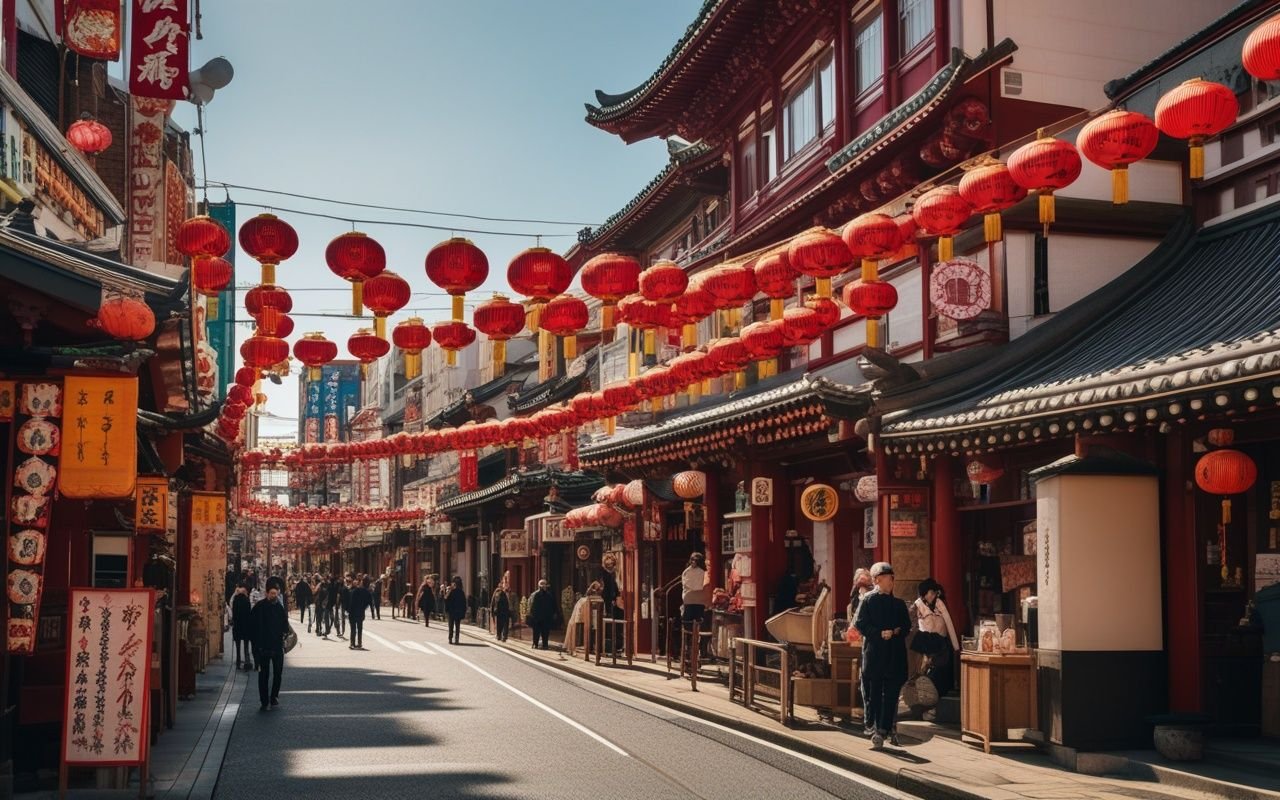
Yokohama Chinatown (横浜中華街, Yokohama Chūkagai) is the largest Chinatown in Japan — and indeed one of the largest in the world. Spanning approximately 500 meters in each direction in the Yamashita-cho district of Naka Ward, it is a vibrant, densely packed neighborhood of over 600 shops, restaurants, and food stalls that attracts over 20 million visitors annually. But behind the neon signs, steam rising from street-level kitchens, and the constant hum of activity lies a rich history that stretches back over 160 years. Chinatown was not built as a tourist attraction — it grew organically from a treaty-port settlement into a living community that has survived earthquakes, war, and urban redevelopment. This guide explores the layers of history embedded in Chinatown's streets, buildings, and food culture.
From ancient temples to living traditions, Kanagawa's cultural heritage offers layers of discovery that reveal themselves with each visit.
Practical Tips
- Zenrinmon (East Gate): The main entrance from Motomachi. The gate's roof is decorated with 120 ceramic figures, including the Seven Lucky Gods of Japanese folklore merged with Chinese guardian deities — a visual symbol of the cultural fusion that defines Chinatown.
- Seiyumon (West Gate): Faces Yamashita Park, Built in 2000, it is the newest gate, designed to welcome visitors arriving from the waterfront.
- Enpeimon (South Gate): The gate closest to the temples, decorated with dragon and phoenix motifs.
- Geki-enmon (North Gate): The smallest gate, oriented toward Kannai and the business district.
- Coin Parking: Available near the station
- Rate: ¥200-300/hour
- Recommendation: Arrive early on weekends
- Wi-Fi: Most major stations and cafes offer free Wi-Fi
I spent hours exploring the temple grounds and learned fascinating details about its 800-year history.